
The four formats of community sponsorship: product, events, content, affiliation
Community sponsorship is the community marketing mechanic for backing communities you do not own. The four things you can ask for, product, events, content and affiliation, and the currency each one costs.
 Marguerite Japy, Co-founder & CEO · September 9, 2026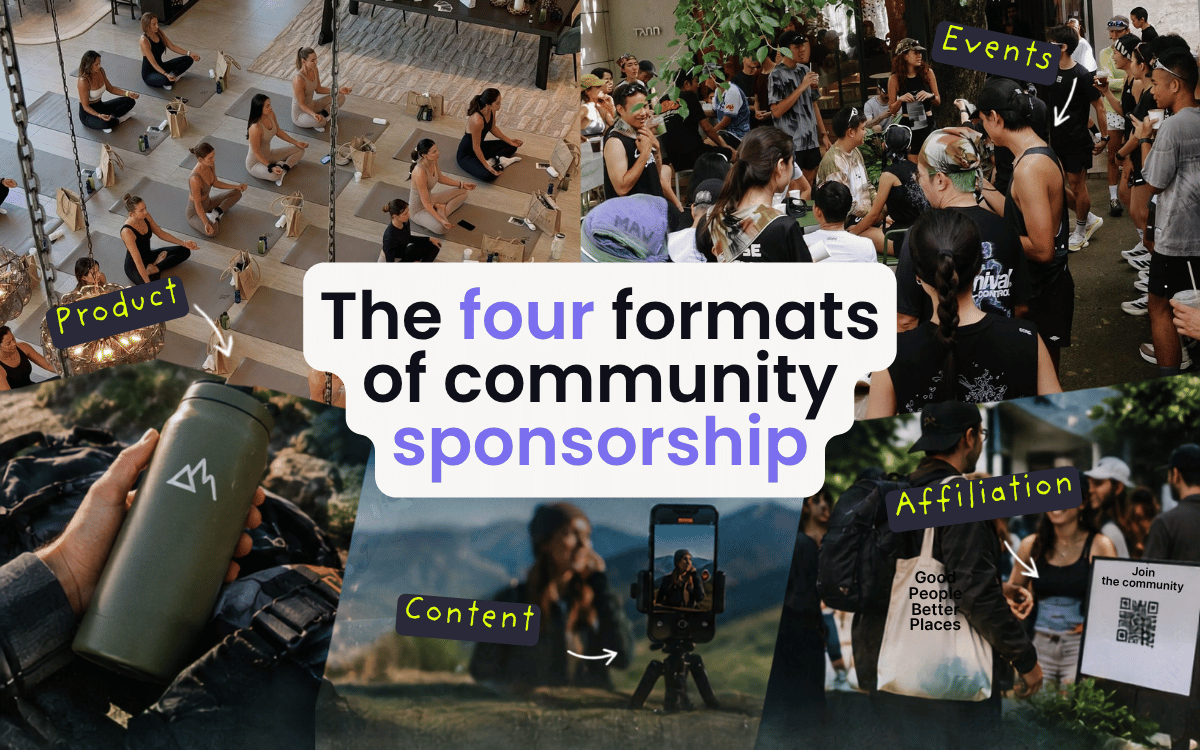
Community sponsorship is what happens when a brand backs a community it does not own. A run club, a supper club, a climbing gym, a founders' breakfast. The brand gives something the community needs, and gets access, presence and credibility in return.
Community sponsorship sits inside community marketing. Community marketing is the category: reaching people through the groups they belong to rather than through a feed. Within that category, two very different practices carry the same name. One is building a community you own, your Discord, your Slack, your customer forum. The other is backing communities that already exist and belong to someone else. This article is about the second, and community sponsorship is what that deal is called.
Naming it matters because it tells you what you are buying and which budget it comes from. "Sponsorship" on its own conjures a logo on a jersey, and that is the association worth killing early.
What it is not
Stadium sponsorship buys attention from a crowd that happens to be looking your way. You pay for the surface, you measure impressions, and the relationship ends when the season does.
Community sponsorship buys participation in something small and repeated. Fifty people at a run club every Tuesday is not a smaller version of fifty thousand at a stadium. It is a different asset: high trust, high frequency, and a leader whose recommendation carries weight because they have nothing to gain from lying to their members.
The practical consequence is that you cannot buy it by the impression. You scope it, you run it, and you measure what people did afterwards.
The four families
Every community sponsorship has two sides: what you give, and what you ask for. The four families are named after the second, because that is what you are actually buying. Each one has its own currency on the other side.
Product. You ask for real trial and honest feedback: members using the thing, a testing panel, a trail crew wearing the gear on a trail. You give product, paid out of cost of goods rather than media budget. This is the family with the lowest cash cost and the highest conviction rate, because a product that has to be tried cannot be argued into someone.
Events. You ask for presence at a moment that already matters to them. You give cash: the bar tab, the venue, the entry fees, the evening built around your launch. This is where most of the money goes, and it buys the deepest memory, because people remember who paid for the night they had.
Content. You ask for material you can reuse: photos from the retreat, a member explaining why the product works, the club's own recap post. You give a fee, or you barter it against the rest of the deal. Content is a family and not an afterthought, because deciding in advance who shoots what and who owns it changes the economics of everything else you ran.
Affiliation. You ask for their recommendation in a form that travels: a code, early access, an ambassador role with a real brief. You give margin, on sales that actually happen. This is the family that compounds, and the only one where the community keeps working for you between activations.
What you give, what you ask for
Separating the two sides is what makes a sponsorship budget legible. Ask for product trial, give product at cost of goods. Ask for presence, give cash. Ask for content, give a fee or a barter. Ask for recommendation, give margin.
Only one of those four is a new line of cash. That is the answer to the question a CFO asks first, and it is why a programme can start almost entirely in kind. Sponsorship has always come in two currencies, cash and value in kind, and both are standard.
It is also what separates sponsorship from media buying. In media you specify the deliverable and you pay for the deliverable. In sponsorship you give first, and what you ask for is negotiated with someone who has their own year to run. The left column is the conversation. The right column is the budget.
How to pick
Start from what the community actually lacks, not from what you want to say.
A club with a full calendar and no budget needs events funding. A club whose members already own three competing products needs seeding, because your argument is physical. A community with a strong leader and a weak feed needs content. A community whose members keep asking each other for recommendations is already doing affiliation for free, and you are just formalising it.
The failure mode is running the family that suits your marketing plan instead of the one that suits their year. It reads as advertising, the leader loses standing with their members, and you have bought a single transaction instead of a relationship.
What to measure
Impressions are the wrong unit here, and reaching for them is how sponsorship got its reputation. What you can measure instead: how many people had genuine contact with the product, what that contact cost, how many of them told someone else, and how much organic reach and trackable conversion came out the other side.
Those numbers are smaller than paid social numbers. They are also real, which is the entire point of the trade.
Frequently asked questions
What is community sponsorship?
Community sponsorship is the community marketing mechanic in which a brand backs an IRL community it does not own, such as a run club, a supper club, a climbing gym or a founders' breakfast, in exchange for access, presence and credibility. The brand contributes product, event funding, content budget or an affiliation deal, and the community keeps its independence. It differs from stadium or logo sponsorship in that the audience is small, high-trust and recurring rather than large and anonymous.
How is community sponsorship different from community marketing?
Community marketing is the category and community sponsorship is one mechanic inside it. Community marketing covers every way a brand reaches people through the groups they belong to, including building a community it owns, such as a Discord or a customer forum. Community sponsorship is the narrower practice of backing communities that already exist and belong to someone else, paid in product, event funding, a content fee or affiliation margin. A brand can run both, and they draw on different budgets.
What are the four types of community sponsorship?
Product, events, content and affiliation. They are named after what the brand asks for, and each has its own currency on the other side: ask for product trial and you give product at cost of goods; ask for presence at an event and you give cash; ask for content and you give a fee or a barter; ask for recommendation and you give margin on the sales that follow. Most programmes combine two or three.
What does a brand give in a community sponsorship?
One of four currencies, depending on what it is asking for: product at cost of goods, cash for an event, a fee or a barter for content, or margin on sales for affiliation. Only the events family reliably needs new cash, which is why a community sponsorship programme can start almost entirely in kind.
Do you need a cash budget to sponsor a community?
Not to start. Three of the four families are paid in something other than new cash: product comes out of cost of goods, content is often bartered against the rest of the deal, and affiliation is paid out of margin on sales that actually happen. Events is the family that needs real money. Many brands run a first season almost entirely in kind, then add cash once they know which communities convert.
How do you measure community sponsorship?
Not in impressions, which is how sponsorship earned its reputation for being unmeasurable. The useful metrics are how many people had genuine contact with the product, what that contact cost, how many told someone else, and the organic reach and trackable conversions that followed. The numbers are smaller than paid social numbers and they describe behaviour rather than exposure.
How is community sponsorship different from influencer marketing?
Influencer marketing rents one person's reach and puts your brand in front of their audience. Community sponsorship puts your brand inside a group that already shares values, rituals and trust, where the recommendation travels between peers rather than down from a single account. The reach is smaller and the conversion depth is higher.