
How to differentiate your brand in a saturated paid social market, and where to move the budget
Paid social doesn't just cost more each year, it makes every brand look the same. Here's why saturation is a differentiation problem, not just an efficiency one, and a practical playbook for reallocating budget toward community marketing.
 Marguerite Japy, Co-founder & CEO · August 31, 2026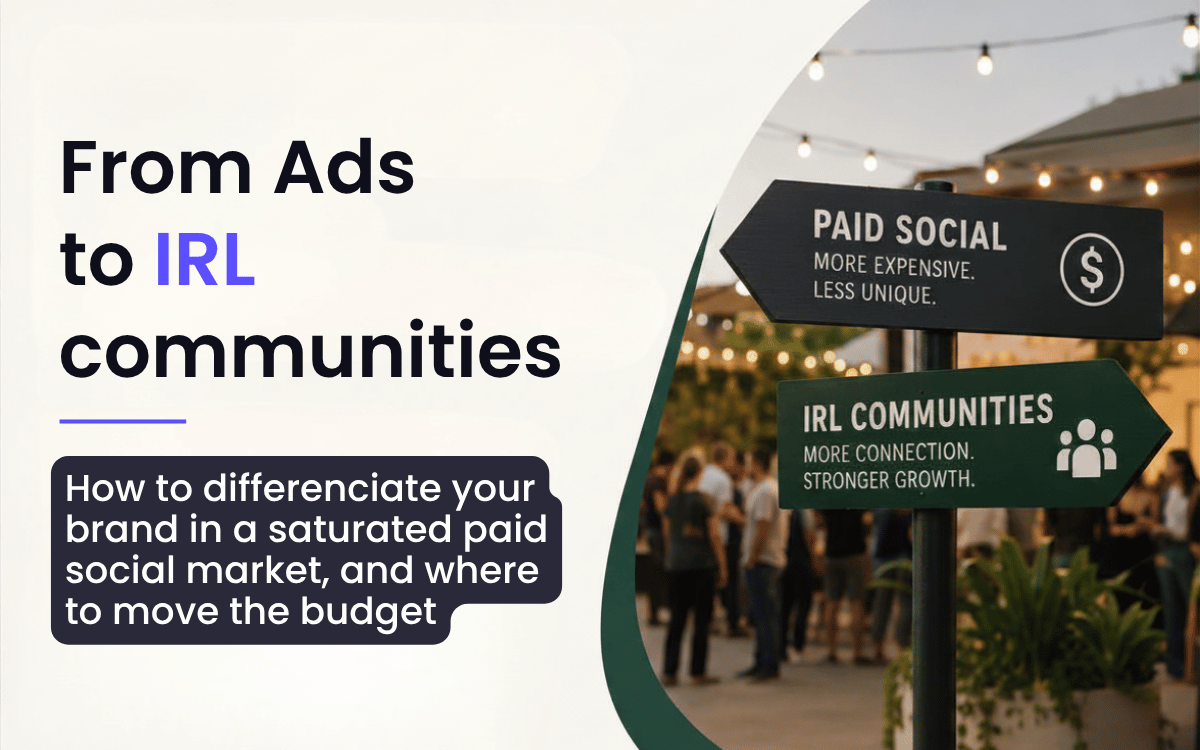
The complaint marketing managers make about paid social usually gets filed under "efficiency": CPMs are up, ROAS is down, the algorithm wants more budget for the same results. That framing misses the real damage. Saturation doesn't just make paid social more expensive, it makes every brand running it look interchangeable.
The platforms optimize toward what already works, and "what already works" converges fast across an entire category. Skincare brands end up with the same three ad formats, the same testimonial-style UGC, the same before/after structure, because the algorithm rewards whatever the algorithm already rewarded. Your creative team isn't running out of ideas, they're being funneled into the same fifteen ideas as every competitor targeting the same lookalike audience.
That's the real cost of a saturated paid social budget: not just declining returns, but a slow erosion of anything that makes a brand recognizable as itself. A customer who sees five nearly identical ads in one scroll session doesn't remember which brand made which claim. Differentiation dies quietly, well before ROAS drops enough to trigger a budget review.
Why the fix isn't better creative, it's a different room
More creative testing inside the same channel doesn't solve a structural problem. The algorithm will keep pulling every brand's best-performing ad toward the same handful of winning patterns, no matter how many variants get tested. Differentiation has to come from somewhere the algorithm can't standardize: a specific room, with a specific group of people, that no competitor has access to on the same terms.
That's what community activation offers that paid social structurally can't: presence inside a group your competitors aren't in. A run club, a supper club, a padel league. The activation itself, not just the creative wrapped around it, is different by construction, because the room is different. Nobody else sponsoring that specific event, gifting that specific group, or running that specific ambassador program is a coincidence a saturated feed can't produce.
Where to actually move the budget
Reallocating budget away from paid social doesn't mean cutting it to zero on day one. It means treating community activation as a real line item with its own targeting, brief, and measurement, the way paid already gets that treatment, instead of a one-off "brand moment" that never repeats.
- Seed: Move a limited-edition or new product into the hands of a specific community before it goes wide. Real trial from a group your competitors can't reach.
- Sponsor: Fund or show up at an event or retreat your customers already care about, instead of running another awareness campaign to people who've never heard of you.
- Reward: Give members of a matched community early access, discounts, or an affiliate structure, so advocacy has a direct channel back to the brand.
- Amplify: Turn what happened at the activation into the actual content: UGC and branded content grounded in something real, not another studio shoot competing for the same three seconds of attention.
A useful starting split for a marketing manager building the case internally: move 10 to 15% of paid social budget into two or three activations for a single quarter, keep the rest running as-is, and compare what each channel actually produces per dollar, not just per impression.
Proving it to a CFO who only trusts paid social numbers
The reason paid social budgets are hard to shrink isn't that they perform better, it's that they're the only channel with a dashboard. Community activation needs the same discipline: a genuine interest rate instead of a reach number, a cost per genuine interaction instead of a CPM, and a word-of-mouth coefficient that shows whether the activation is actually generating repeat mentions after the event ends. Without numbers in that shape, "it felt authentic" will lose every budget conversation to a CPM.
Frequently asked questions
How much budget should I actually move to test this?
Enough to run two or three real activations in a quarter, not one. A single sponsorship is a data point, not a channel. Most marketing managers start with 10 to 15% of paid social spend and expand once the numbers hold up.
Do I need to cut paid social entirely to see a difference?
No. This works best as a second channel running alongside paid, not a replacement for it. The goal is reducing over-reliance on a channel with declining differentiation, not zeroing it out.
What KPIs actually convince a CFO?
Numbers structured the same way paid ones are: a genuine interest rate, a cost per genuine interaction, and a word-of-mouth coefficient that tracks whether people keep mentioning the brand after the activation ends, not just during it.
How long before this shows results?
A single activation shows engagement data within weeks. Differentiation and repeat word-of-mouth compound over two to three quarters of consistent presence in the same communities, not from a one-off campaign.
Does this require a bigger team than running paid social?
It requires a different skill: briefing and managing real-world activations instead of ad creative. Most teams already have this from event or partnerships work, it just hasn't been treated as a repeatable, measured channel before.