
Run club sponsorship: six examples, and what each brand actually bought
Six named brands that sponsored a run club, sorted by what each one asked for: product trial, an event, content or affiliation. What each deal bought, what it cost, the three things that go wrong, and how the same shape works for a supper club or a book club.
 Marguerite Japy, Co-founder & CEO · September 18, 2026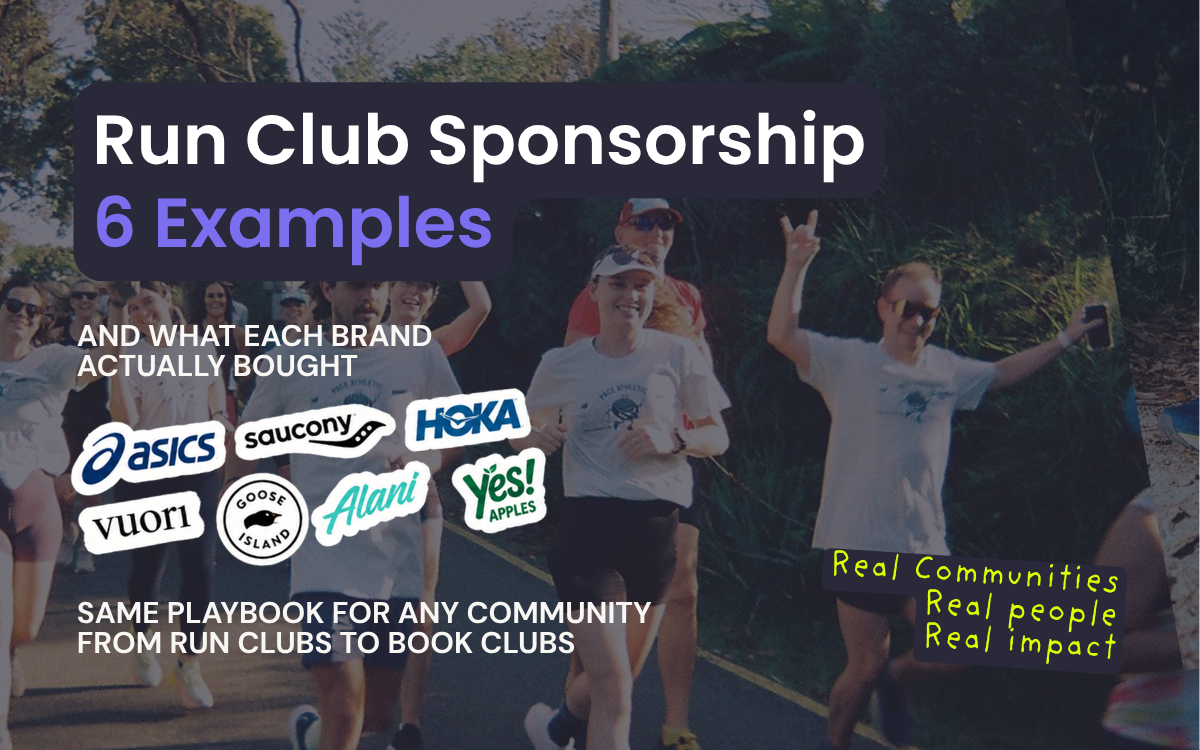
Ask for examples of community marketing and most of what comes back is a brand's own community. A Discord server, a customer forum, an ambassador scheme the brand built and staffs. Those are real, but they answer a different question. The harder one is what it looks like when a brand backs a community that already exists and belongs to someone else.
Run clubs are where that question has the best answers on record. Strava reported a 59 percent jump in run club participation in 2024, the trade press followed, and clubs themselves publish their partners openly. So this is where you can actually see the deals rather than infer them.
Here are six, sorted by what the brand asked for rather than by category. Six rather than sixty, because the useful part is not the roll call of logos. It is what each deal bought and what it cost. Sources are at the end, and where a figure comes from a brand rather than from an independent measurement, it is attributed to the brand.
Everything here transfers to a supper club, a climbing gym or a book club. That is the last section.
Product: the deals that asked for trial
Asics backed Run Eat Club in Nice from the club's launch in September 2025. The format is a social run followed by the meal, and one outing with Asics and three other partners drew 73 people. What the brand bought there is not reach. It is the shoe on feet that run often enough to have an opinion, in a room where opinions get said out loud over dinner afterwards.
Saucony EU partners with Pimento Running Club in Lyon, founded in summer 2024 around inclusive, safety-first sessions. Members test the shoes. Same currency as Asics: product, not cash, paid out of cost of goods rather than a media line.
Fulton, an insole brand, has sponsored Central Park Track Club, Spartan Sundays Run Club and Skyline Run Club since 2021. It is the most instructive example on this list because it is the only one with published numbers: the company told Modern Retail in January 2024 that 20 to 30 percent of members buy a pair of insoles after an event, and that its club work had reached more than 100,000 people across social. Those are Fulton's own figures rather than an audited result. They are still the closest thing anyone has published to a conversion rate for this kind of deal, and the interesting part is the shape of it. An insole is a product you cannot argue someone into. It has to be under a foot. A club puts it there.
The pattern across all three: the product has to be consumed before it can be judged, and the club supplies both the occasion and the peer group. Those two things are exactly what a sampling budget cannot buy on its own.
Events: the deals that paid for the night
Slow Girl Run Club has run events with Vuori. Goose Island brewed the finisher beer for the Chicago Marathon. Two different scales of the same move: attach to a moment that already mattered to the people there.
Goose Island is the clearer illustration because the alternative was available and obvious. A brewery at a marathon could have bought signage. Instead it made the thing a whole field reaches for at the end of the hardest morning of its year. Signage would have been seen. The beer got held, photographed and remembered, and it cost the brewery beer.
Hôtel Amour Nice hosts Run Eat Club's monthly meeting, which is the same mechanic pointed the other way: a hospitality brand buying presence inside a running community, rather than a sports brand buying presence at a dinner. Worth noting because it is the version most brands miss. You do not have to be endemic to the category to back a club. You have to have something the club needs, and a room is something a club always needs.
Events are where cash actually moves. Someone pays the venue, the bar tab, the coffee. The versions that work attach to something the group was going to do anyway, rather than inventing an occasion and hoping people come.
Content: the family you get whether you asked for it or not
Every partnership on this list produced content, whether or not it was in the deal. Fifty people running in branded kit, a testing session, a finish line with your product on the table: photos get taken, stories get posted, the club's own account recaps the night.
That is the part brands underrate. A community partnership is one of the few places a brand gets footage of real people using the thing in the place they actually use it, shot by people the audience already follows. Nobody was cast. The setting is real, the reaction is real, and the person posting has no contract obliging them to like it. A studio shoot cannot manufacture that, and an influencer brief buys a version of it that everyone can tell was bought.
So the difference between these deals is not whether content happened. It is whether anyone agreed in advance who shoots it, who owns it and where it can run. Almost no public account of a brand and club partnership says. Fulton's social work and its 100,000-person reach figure are the closest thing here to content treated as a deliverable with terms attached.
That gap is worth closing before the event rather than after. An opinion piece in The Drum in June 2025 named the same thing from the other side: one of the misses it listed was failing to build a moment worth posting, on TikTok or on Strava. Deciding what that moment is, and who can use what comes out of it, costs nothing at the briefing stage and is awkward to raise once the photos are on someone else's phone.
Affiliation: the deal that asked for the recommendation
Fulton gives club members order discounts. That is the smallest version of affiliation and the easiest to start: a code, tracked, costing margin only on sales that happen.
It is also the family with the fewest public examples, and the reason is worth naming. A code's performance is exactly the number a brand does not publish. Read the silence as a gap in the reporting rather than as evidence that nobody is doing it.
What goes wrong
The Drum's June 2025 piece named three misses, and they work as a checklist:
- Treating the partnership as product placement, and missing what the group is actually there for.
- Over-weighting the digital plan while under-investing in showing up in person, repeatedly.
- Building nothing anyone wants to share.
The through-line across the six is that the brand plays support and the community stays the lead. Asics did not turn Run Eat Club into a shoe launch. Hôtel Amour did not rename the run. The deals that get written up approvingly are the ones where the group would still recognise itself with the logo removed.
What this looks like outside running
A club is any group that meets on a schedule with someone at the front of it. The running examples above are not a category, they are a shape, and the shape holds:
- A supper club is an events deal that is already catered. The brand pays for the night and its product is on the table, which is the Goose Island move at a table of twelve instead of a finish line.
- A climbing gym is a product deal with a longer trial. Shoes, chalk, tape and harnesses get used to destruction by people who compare notes in the queue for the wall, which is the Asics mechanic on a slower clock.
- A book club is an affiliation deal waiting to happen. One recommendation to a group that meets monthly and trusts the person making it, which is the family with the fewest public examples and the lowest cash cost.
- A founders' breakfast, a gaming crew, a ceramics studio, a surf club: same four questions. What does the group already do, what does it lack, what can you give from stock rather than from budget, and what do you ask for in return.
If you are looking for examples in your own category and finding none, the likelier explanation is that nobody has written them up yet. The absence of a case study is not the absence of a practice.
What the six have in common
None of them bought impressions. Every deal here is scoped as an activity, not as a surface.
All of them attached to something the group already did on a schedule. Not one is a brand-invented occasion.
The cheapest ones in cash were the product ones, paid out of cost of goods rather than media budget. That is what makes a first programme possible without opening a new line.
And in every case the community kept its name. That is not politeness. It is the thing being bought.
Sources
- https://www.modernretail.co/marketing/as-running-clubs-explode-in-popularity-brands-are-tapping-these-groups-for-sampling-opportunities-and-sponsorships/
- https://www.thedrum.com/opinion/the-new-rules-brand-engagement-according-run-clubs
- https://www.cotedazurinsider.fr/run-eat-club-nice-running-social-gourmand/
- https://therundrop.com/clubs/pimento-running-club--27819296
Frequently asked questions
What is run club sponsorship?
A brand backing a running club it does not own, in exchange for trial, presence, content or a recommendation. Asics supporting Run Eat Club in Nice, Saucony partnering with Pimento Running Club in Lyon, or Fulton sponsoring three New York run clubs. The common feature is that the community is not owned by the brand and keeps its own name.
What does a brand actually get from sponsoring a club?
It depends on what it asked for. Product trial buys informed opinion in a group where opinions circulate. An event buys presence at a moment that already mattered. Content buys unstaged footage of real use. Affiliation buys a recommendation that keeps working between activations.
How much does it cost to back a community?
Product trial costs product at cost of goods. An event costs cash for the venue and the evening. Content costs a fee or a barter. Affiliation costs margin on sales that happen. Only one of those four is a new line of cash, which is why most first programmes start in kind.
Does club sponsorship only work for running?
No. Running is over-represented in public examples because the category grew fast and got covered, not because the mechanic is specific to it. A supper club, a climbing gym, a book club or a founders' breakfast works the same way: a group that meets on a schedule, with an organiser at the front of it.
Is this the same as influencer marketing?
No. An influencer partnership buys one person's audience. Backing a community buys access to a group that meets whether or not the brand shows up, and whose organiser has no incentive to oversell to its own members.