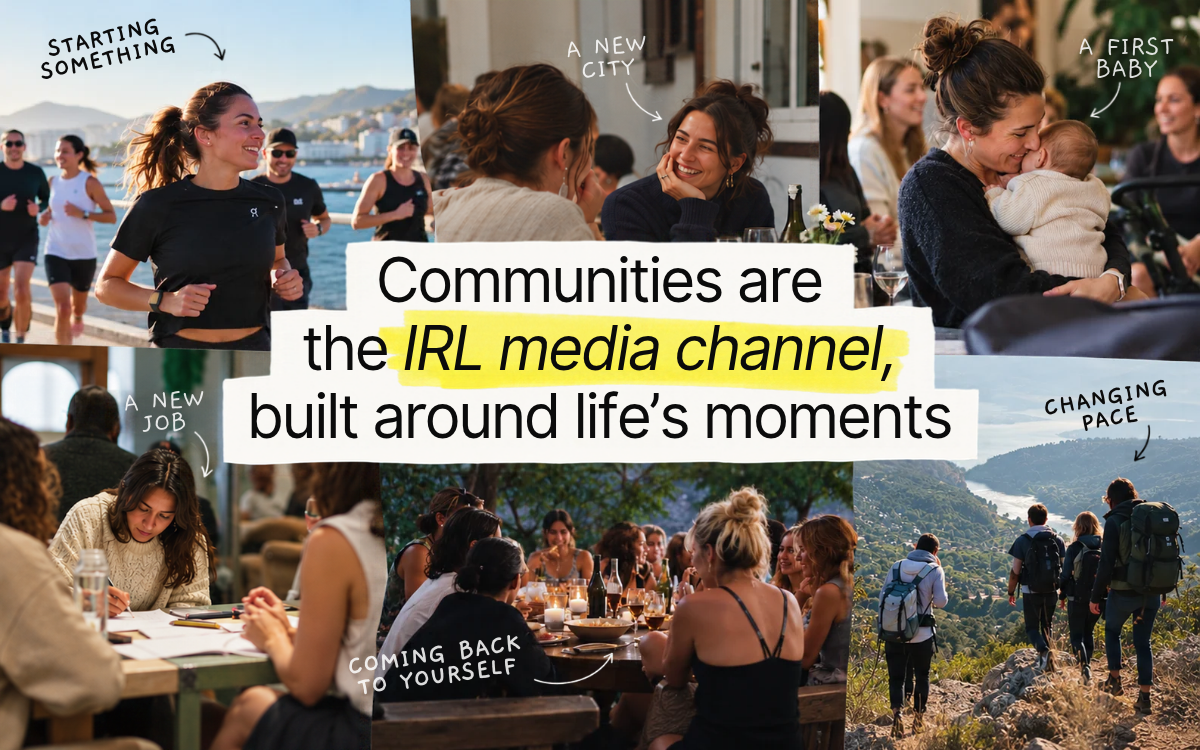
Communities are the IRL media channel, built around life's moments
An interest is often what gets someone through the door, but a change in their life is often what brought them looking. A life moment changes what someone needs, and communities are where people going through the same moment find each other. That makes them a place where a brand can reach people by moment, not only by age or interest.
 Marguerite Japy, Co-founder & CEO · October 26, 2026
Media planners talk about audiences. Segments, interests, lookalikes. But nobody lives as a segment. People live through moments: a new city, a new job, a first baby, a first marathon, a breakup, a retirement. And at almost every one of those moments, they go looking for other people.
That is what a community is. Not a list of followers, but a group of people who found each other because their lives rhymed at the same time. Which is why communities work as an IRL media channel: one organised around life's moments, which say more about what someone needs than age, gender or interest alone.
1. A feed knows what you clicked, a community knows what just happened to you
A feed infers. It watches what you linger on and guesses who you are. It is good at interests, but it can only read a change in your life once that change shows up in your behaviour, which is after the fact.
A community works the other way round. The interest may be what you search for, but very often the event is why you are searching. People rarely end up in a new-mums walking group by accident, and a run club for beginners mostly attracts people who have just decided to start running. Being a member is a signal of the moment, and it exists while the person is still open to change.
That is the difference that matters for a brand. Demographics describe who someone is on paper. Interests and preferences describe what they like or say they want. Belonging to a community describes what they actually chose to do, with other people, at a particular point in their life. That is why we think it predicts what someone will need next better than any of the three, and a community is where it is visible.
2. Moments are when habits get rewritten
Most of what we buy runs on habit. The brand of coffee, the gym, the bank, the shoes. Habits are sticky precisely because nothing forces us to look at them again.
A life moment is the exception. Moving to a new city breaks every routine at once: where you shop, who you see, how you spend a Saturday. A new job, a new baby, a new fitness goal do the same. For a while, the person is rebuilding their defaults from scratch.
Brands know this, which is why they target movers, the newly engaged, new parents. The difficulty is reaching them without being intrusive or late. A community answers both: the person chose to be there, so it is not intrusive, and they are there while the moment is still happening, so it is not late.
3. The moments communities are built around
Behind the interest on the surface, many communities are built around one of a few moments.
- Arriving somewhere new. Newcomer dinners, expat groups, city welcome clubs. The interest is a meal or a language. The moment is being alone in a place where you know nobody.
- Starting something. A first run, a first climb, a first language class. Beginner groups exist because the hardest part is showing up alone.
- Changing role. Becoming a parent, a founder, a manager, a caregiver. Peer groups appear because the people around you cannot quite explain what you are going through.
- Changing pace. Career breaks, sabbaticals, retirement. The community fills the structure the job used to provide.
- Coming back to yourself. After a breakup, an illness, a loss. Wellness circles, walking groups, open-water swimmers, book clubs that meet because the members needed somewhere to go on Thursday.
The activity is how people find each other. The moment is often what makes them stay.
4. What this means for how a brand shows up
If the community is organised around a moment, the best sponsorship is the one that is useful inside that moment. Not a logo near it.
A few examples of the difference:
- A running shoe brand in a beginners' run club is not buying exposure. It is there on the day someone is deciding whether running is for them, with the first pair of shoes they will buy for it. The brand is part of the first month of a new habit.
- A furniture or home brand supporting a newcomers' group in a new city is present when people are building a home from nothing, and when every recommendation from a neighbour carries weight.
- A food brand at a supper club for new parents is not interrupting dinner. It is giving a tired group one less thing to organise, and a group is likely to remember who helped.
In each case the question is the same: what does a person need at this stage, and can the brand make it easier? The answer is rarely an ad. It is a product in the right hands, a night someone did not have to plan, a discount that actually matches the budget of that stage.
5. Why it works as a media channel, not just a favour
Calling communities a media channel is not a metaphor. A media channel gives a brand a place to be seen by a defined group, at a predictable moment, with a format that fits. Communities do all three, with some differences that are in their favour.
- The audience is defined by the moment, and by the choice to belong, which we think says more about what someone needs than demographics, interests or preferences, and which a feed only sees after the fact.
- The format is a real encounter: a session, a table, a trip, a weekly ritual. People do not scroll past it.
- The endorsement comes from the host, someone members already trust in person. A brand that is invited in borrows that trust instead of renting attention.
- The content is a by-product. A community partnership produces unstaged footage of real people in the real setting, which is the thing brands keep trying to fake on a set.
What brands often lack is the measurement. That is fair, but it is a measurement problem, not a reach problem. For how to answer it, see: https://ernest-app.com/blog/measuring-what-matters
6. How to pick the moment, then the community
Most brands start from a community list and look for a fit. It is faster to start from the moment.
- Which life moment makes someone reconsider the category you sell in? Be specific: not "fitness", but "the week someone decides to start running".
- Who gathers around that moment? Name three kinds of communities, not three names.
- What would be genuinely useful at that stage, beyond visibility?
- Who is the host, and would they say yes if they were not being paid?
Then look for the rooms. ernest maps real-world communities across France by values, location and member profile, so the search can start from where your customer is in their life.
If you want to see what the formats look like once you have found the right room, this walks through the main families: https://ernest-app.com/blog/community-sponsorship-four-families
What happens next
A feed can only react to what you do online. A change in your life happens offline, between people, and a community is where it gets shared.
Three moves for this quarter:
- Write down the two life moments that most often make a customer reconsider your category.
- For each, list the kinds of communities that form around it.
- Pilot one activation in one of them, with something useful at that stage, and measure what members say afterwards.
Frequently asked questions
What does it mean to call communities the IRL media channel?
It means treating a community as a place where a brand can reach a defined group of people in person, at a predictable time, in a format that fits, in the way a magazine or a podcast is a place. The difference is that the audience often gathers around a shared life moment as well as a shared interest.
What is a life moment in marketing?
A life moment, or life event, is a change that disrupts a person's routines and makes them reconsider what they buy: moving, starting a job, becoming a parent, taking up a new sport, retiring. Habits are rewritten during these periods, which is why brands have long targeted them.
Why are communities better than ads for life moments?
Ads infer the moment from online behaviour, so they tend to reach the person after the moment has started. People often join a community because of the moment, so membership is a direct signal, and the brand shows up inside the experience instead of interrupting it.
How can a brand work with a community around a life moment?
Start from the moment, not the interest. Identify what a person needs at that stage, find the kinds of communities that form around it, and offer something genuinely useful to the group, such as product seeding, an event sponsorship or an ambassador programme, agreed with the host first.