
Looking for an alternative to influencers? You're searching for the wrong thing
Paid social is getting more expensive and sponsored posts get less genuine reaction. The fix is not another influencer tool. It is showing up inside real-world communities where trust already exists, and measuring it the same way finance measures paid.
 Marguerite Japy, Co-founder & CEO · September 23, 2026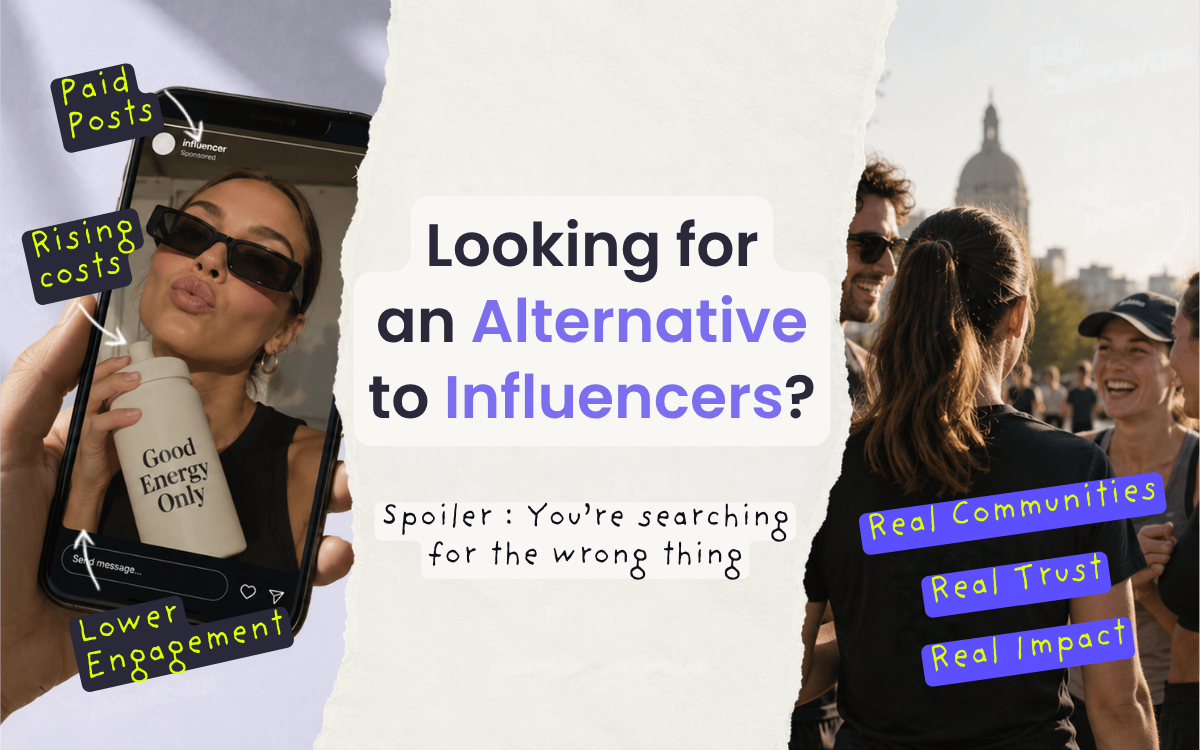
Brands looking for an alternative to influencers usually expect a list of new platforms, new creator tiers, new reporting tools. That's the wrong search.
The real shift isn't from one influencer tool to another. It's from paid attention to earned trust: from renting a feed for a week to showing up inside a room that already trusts its host. This briefing is for CMOs about to renew (or finally cut) an influencer line they can no longer justify to finance.
1. What's actually breaking
Two numbers should be on every CMO's desk before the next budget cycle:
- Paid social costs have climbed roughly 60% over five years, while the same spend buys a shrinking share of attention.
- Influencer engagement rates have fallen sharply since 2022, even as sponsored-post volume keeps rising. Brands are paying creators more often for less genuine reaction per post.
Put those two lines on the same chart and the conclusion is hard to miss. The two channels CMOs have leaned on hardest for a decade are both getting more expensive per unit of real attention. Impressions can still look fine in a slide deck. Impressions are not the same as someone caring.
We dig into the paid side of this in a separate piece: https://ernest-app.com/blog/why-digital-ad-roi-is-declining
2. Why another influencer tool isn't the fix
Most answers to "what's the alternative to influencers" just offer a different way to book the same creator economy: different discovery filters, different contract templates, different reporting layered on top of sponsored posts. That solves a sourcing problem. It doesn't solve the trust problem.
The format itself is what's losing ground: a paid post in a feed, disclosed as an ad, competing with a dozen other paid posts in the same scroll. Swapping vendors doesn't change the format.
To be clear, this isn't an argument for abandoning paid media or influencer relationships. Brands aren't replacing paid channels. They're adding a more targeted layer on top of them, and that layer is where real-world communities come in.
3. The alternative: showing up where trust already exists
Instead of renting a creator's audience for one post, a brand can become a patron of a community that already has built-in trust: a run club, a supper club, a founders' group, a wellness collective. Members didn't opt into an ad feed. They opted into a group.
ernest has mapped more than 25,000 of these real-world communities across France (sweat clubs, smart clubs, hospitality clubs, fandom clubs) by values, location and member profile. The point is to find the room that fits your product, not the influencer whose bio happens to match a hashtag.
Activations that work inside this kind of trust look different from a sponsored post:
- Product seeding inside a run club or coworking community, reaching people who already do the thing your product serves.
- Event sponsorship where the brand supports something that already happens, instead of staging its own stunt.
- Ambassador programs built with organizers and regulars who bring in their own peers, so a trial arrives with context already attached.
- Content made by the community, for the community, instead of scripted for a feed.
Each of these borrows the host's trust instead of interrupting it, which is the opposite of what a sponsored post does. For the full range of formats, see the four families of community sponsorship: https://ernest-app.com/blog/community-sponsorship-four-families
4. Where CMOs get stuck: proving it to finance
Community spend has historically lived as a soft brand line: nice anecdotes, no number finance can put next to CPM or CPA. That's the real reason budgets stay in paid and influencer channels even as they underperform. At least those produce a report.
Closing that gap is a core part of why ernest exists. The questions worth answering after every activation are simple: did people genuinely engage, did it spread without media spend behind it, did members talk about it afterward, and did it move purchase intent? Answered the same way each time, those become numbers you can put next to your paid and influencer lines. That makes the budget meeting a comparison instead of a gut feeling.
If you're rebuilding that business case now, this walks through the approach: https://ernest-app.com/blog/measuring-what-matters
And this covers the numbers side of a community budget: https://ernest-app.com/blog/community-marketing-budget
5. What this looks like in practice
A few formats brands are already running instead of booking another round of sponsored posts:
- Sponsoring a run club's weekly session instead of paying a fitness creator for a single post. Six real deals, and what each brand bought, are here: https://ernest-app.com/blog/run-club-sponsorship-examples
- Turning community organizers into ambassadors, so a product arrives through someone members already know in real life, not through an algorithm.
- Running it as one program, not twenty email threads. Outreach, briefs and follow-up per community are what usually eat weeks of a marketing team's time before a single activation goes live. ernest handles that coordination with you.
If you want the side-by-side comparison first, start here: https://ernest-app.com/blog/community-marketing-vs-influencer-marketing
What happens next
The brands that win the next decade won't be the loudest. They'll be the ones who showed up consistently, in enough of the right rooms, that word of mouth started doing the work paid media used to do alone.
Three moves for Monday morning:
- Pull your influencer engagement numbers from the last four quarters. Chart the trend before you renew anything.
- Ask finance how community spend is currently benchmarked. If the answer is "it isn't," that's the first fix.
- Pick one community close to your product (a run club, a founders' group, a hobby group) and pilot a patron-first activation this quarter instead of a fifth sponsored post.
None of this means cancelling your paid social budget or your influencer contracts. It means adding a layer on top of them, measured the same way, so the next budget conversation is a comparison instead of a guess.
Frequently asked questions
What are the arguments against influencer marketing?
The core argument isn't that influencers don't work. It's that engagement rates on sponsored posts have been falling since 2022 even as brands publish more of them, so the same budget buys less genuine reaction per placement. Add rising paid social costs, and a pure influencer strategy gets harder to defend to finance every quarter.
What is the best alternative to influencers for brands?
Rather than swapping one creator tool for another, more brands are activating inside real-world communities (run clubs, supper clubs, founders' groups) where trust already exists and doesn't need to be rented post by post. It works as a layer on top of paid and influencer channels, not a full replacement.
What are the four types of influencers?
Influencers are usually segmented by audience size: nano (roughly 1K to 10K followers), micro (10K to 100K), macro (100K to 1M) and mega or celebrity (1M+). Each tier trades reach for engagement differently, but all of them rely on the same format, the paid post in a feed, which is the part losing ground.
How do you measure the ROI of a community activation against an influencer budget?
Track genuine interest, organic reach, word of mouth and purchase intent for each activation, then compare those numbers directly with your paid and influencer lines. That turns community spend from a soft brand line into a channel finance can evaluate.